DIWAN · REGISTER
Reading the register.
Reading the register.
Intelligence with context. Foresight that shapes decisions. The DIWAN register publishes commissioned studies, briefings, and market intelligence across sectors and jurisdictions.
 United Arab Emirates 49
 Saudi Arabia 39
 Qatar 14
 Singapore 10
 Oman 6
 Bahrain 4
 China 4
 Guinea 3
 Egypt 2
 Kuwait 2
 Samoa 2
 Sudan 2
 Albania 1
 Algeria 1
 American Samoa 1
 Andorra 1
 Angola 1
 Antigua and Barbuda 1
 Argentina 1
 Aruba 1
 Australia 1
 Austria 1
 Azerbaijan 1
 Bangladesh 1
 Barbados 1
 Belarus 1
 Belize 1
 Bermuda 1
 Bolivia 1
 Bosnia and Herzegovina 1
 Brazil 1
 British Virgin Islands 1
 Brunei Darussalam 1
 Bulgaria 1
 Cabo Verde 1
 Cambodia 1
 Canada 1
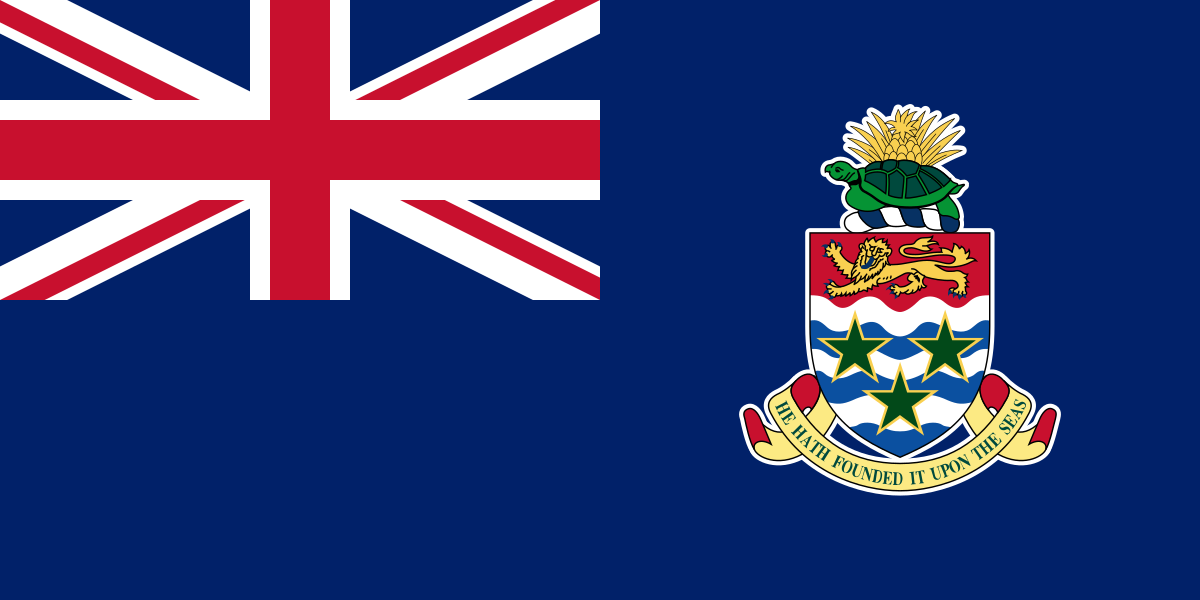 Cayman Islands 1
 Central African Republic 1
 Chad 1
 Channel Islands 1
 Chile 1
 Costa Rica 1
 Croatia 1
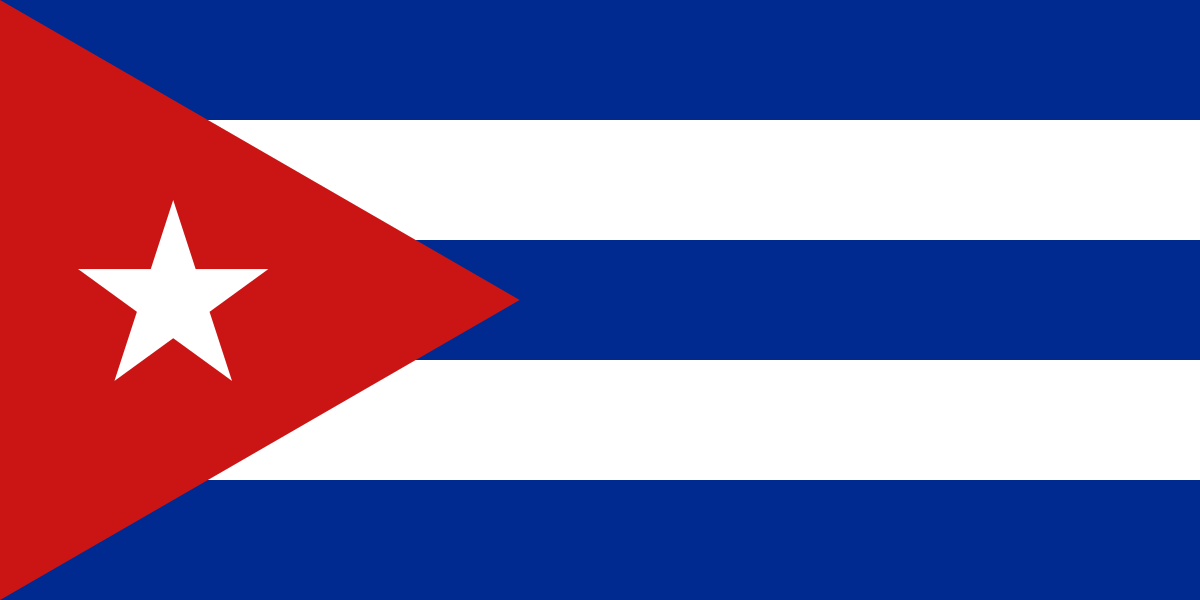 Cuba 1
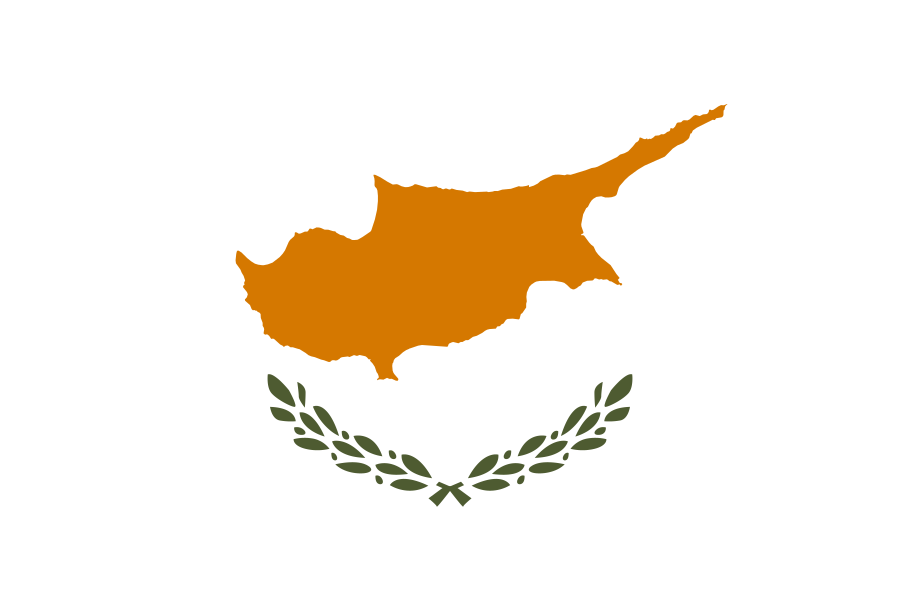 Cyprus 1
 Czechia 1
 Denmark 1
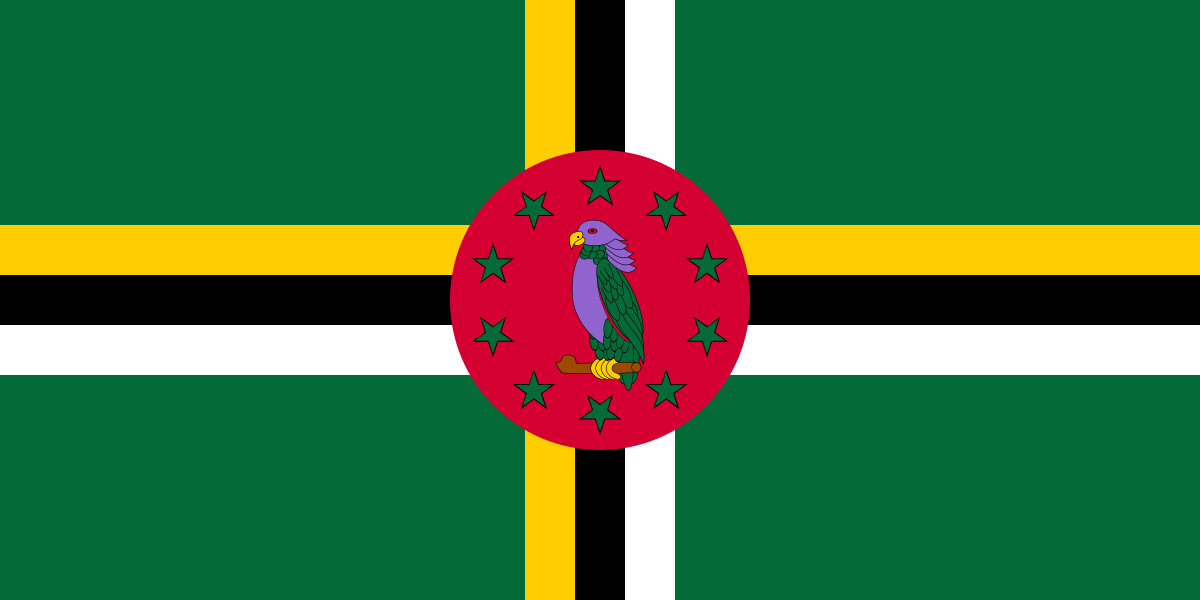 Dominica 1
 Dominican Republic 1
 Ecuador 1
 Equatorial Guinea 1
 Eritrea 1
 Estonia 1
 Eswatini 1
 Finland 1
 France 1
 French Polynesia 1
 Gabon 1
 Georgia 1
 Germany 1
 Gibraltar 1
 Greece 1
 Greenland 1
 Grenada 1
 Guam 1
 Guatemala 1
 Guyana 1
 Haiti 1
 Hungary 1
 India 1
 Indonesia 1
 Isle of Man 1
 Israel 1
 Italy 1
 Jamaica 1
 Jordan 1
 Kazakhstan 1
 Kiribati 1
 Kosovo 1
 Latvia 1
 Lesotho 1
 Liberia 1
 Libya 1
 Lithuania 1
 Luxembourg 1
 Malawi 1
 Malaysia 1
 Malta 1
 Mauritania 1
 Mauritius 1
 Mexico 1
 Monaco 1
 Mongolia 1
 Montenegro 1
 Morocco 1
 Mozambique 1
 Myanmar 1
 Nepal 1
 Netherlands 1
 New Caledonia 1
 Niger 1
 Nigeria 1
 North Macedonia 1
 Northern Mariana Islands 1
 Pakistan 1
 Palau 1
 Panama 1
 Papua New Guinea 1
 Paraguay 1
 Peru 1
 Philippines 1
 Poland 1
 Romania 1
 Rwanda 1
 San Marino 1
 Senegal 1
 Sierra Leone 1
 Slovenia 1
 Solomon Islands 1
 South Africa 1
 South Sudan 1
 Spain 1
 Sri Lanka 1
 Suriname 1
 Sweden 1
 Switzerland 1
 Syrian Arab Republic 1
 Tajikistan 1
 Tanzania 1
 Timor-Leste 1
 Togo 1
 Trinidad and Tobago 1
 Tunisia 1
 Turkey 1
 Turkmenistan 1
 Turks and Caicos Islands 1
 Tuvalu 1
 Ukraine 1
 United Kingdom 1
 Uruguay 1
 Vanuatu 1
 Vietnam 1
 West Bank and Gaza 1
 Zimbabwe 1
Three verified signals from the past 30 days — and who should act on them
Three market signals from the past 30 days show the GCC platform economy entering an institutional phase: a USD 389bn global private-equity house putting its first GCC office on the ground in Abu Dhabi, the UAE topping the Arab Digital Economy Index 2026 with five GCC states in the top performance tier, and platform incumbents pivoting from customer acquisition to share-of-wallet and startup enablement as quick-retail heads toward USD 15bn by 2030. This brief verifies each signal, quantifies it, and maps the concrete moves open to founders, B2B vendors, investors and corporates over the next 90 days.

Three signals from the last 30 days — capital rotation, the onshore exit window, and state-built rails
August 2026 venture capital more than doubled to US$375M with 97% landing in the UAE; Tabby is preparing a ~US$4.5B Tadawul listing that opens the region's onshore platform-exit window; and Saudi and UAE regulators are building the platform rails themselves — from Money20/20 Riyadh to the AlTareq open-finance mandate. What is moving, and who should act.

A demand-driven legal review answering the questions readers put to the platform most — mainland vs ADGM vs DIFC, what boards owe, and what employment exits cost
Reader demand on the platform clusters on three questions: where to incorporate in the GCC, what directors owe once incorporated, and what employment exits cost. This study answers all three — a six-door comparison of UAE mainland, ADGM, DIFC, Saudi Arabia, QFC and Bahrain/Oman; the ADGM directors'-duties framework in plain language; and the notice and end-of-service formulas for DIFC, ADGM and the UAE mainland — with indicative costs and a decision playbook by profile.

Evaluating Economic, Social, and Environmental Dynamics
The United Arab Emirates is expected to maintain a robust economic profile, with a projected GDP of USD 552.3 billion in 2024 and a real GDP growth rate of 4%. The population is forecasted to reach 11.5 million by 2025, driven by a growth rate of 4.7%. Additionally, the country will continue to exhibit high urbanisation and connectivity levels, supporting its status as a regional hub for trade and technology.

HUMAIN races to market for data-centre money while ADGM posts a 54% AUM surge — the Gulf platform buildout turns from sovereign cheque-book to open capital markets
Two September 2026 signals — Saudi Arabia’s HUMAIN beginning IPO preparations and raising a US$2.5bn domestic data-centre fund (6–9 Sep), and Abu Dhabi’s ADGM reporting 54% AUM growth with over US$100bn of AI-focused capital (8 Sep) — mark the moment the GCC’s platform buildout starts financing itself through open markets rather than sovereign equity. This study reads the two signals together, maps the capital stack forming around Gulf compute, and identifies who should act, and when.

Third reading of the Ask-desk demand signal: gratuity, notice, savings schemes and nationalisation quotas — the employment rulebook actually in force across the GCC in 2026, and what it costs to get it wrong
Readers of the legal platform keep asking a third family of questions after formation and directors' duties: how to hire, pay out and let go. This edition answers the recurring asks — end-of-service gratuity, notice periods, the quiet shift from accrued gratuity to funded savings (DEWS and the UAE federal scheme), the 2025 Saudi labour-law amendments, ADGM's 2024 Employment Regulations, and the Emiratisation penalty escalator — with worked numbers and a 90-day employer playbook.

Two signals from the last 30 days — Keeta's Gulf operation turns profitable and Tabby prices at $6.5 billion — mark the end of growth-at-any-cost in the Gulf platform economy, and the playbook for who should act
In the 30 days to 21 September 2026, the GCC platform economy crossed a line it has been approaching for two years: platforms stopped being priced and judged on growth alone, and started being priced and judged on profit. Two signals carry the shift. First, reporting on 9 September confirmed that Keeta — Meituan's international arm — reached profitability in Saudi Arabia in July 2026, roughly 22 months after entering, while building the UAE into its second-largest market across all seven emirates. The subsidy-led Chinese entry playbook is now a self-funding beachhead, and the cost is visible in incumbent accounts: Talabat grew Q2 GMV 11% yet surrendered 18% of net income defending wallet share. Second, on 14 September Tabby closed a $233 million round at a $6.5 billion valuation led by Blue Pool Capital — pricing a Riyadh-headquartered platform above Klarna, its global archetype, on the strength of licences, profitability since 2023 and $18 billion in annualized volume. This study reads the two signals together, quantifies what is moving, and sets out who should act: merchants with a rare negotiating window, incumbents forced into subscription and multi-vertical defence, investors ahead of a Tadawul pipeline, and founders for whom profitability is now the ticket to capital.

Six regimes rewired in 24 months — what changed, what is imminent, and the operator playbook for Q4 2026
Between September 2025 and October 2027 the UAE is re-platforming its entire federal compliance stack: a new Central Bank law, a replacement AML statute with personal manager liability, mandatory e-invoicing, corporate-tax cycle 2 with the 15% DMTT, phased Open Finance, and universal GHG reporting. This watch brief maps each change, the hard dates bracketing Q4 2026, the quantified penalty exposure, and a practical operator action plan.

A 30-day read on the Gulf platform economy — a hard regulatory ceiling lands in Kuwait while platform mega-capital concentrates in the UAE
Two market signals defined the last 30 days for platform businesses in the GCC. First, Kuwait became the first Gulf state to impose binding price controls on intermediary platforms: from 1 September 2026, commissions are capped at 17% (10% where merchants self-deliver) and delivery fees at KD 1 per order, with algorithm-fairness, ad-labelling and data-sharing duties attached. Second, August 2026 venture data shows platform capital returning to the region at $375M (+117% month-on-month) but concentrating to an extreme degree: the UAE took roughly 97% of all capital, driven by two platform Series C mega-rounds (Moove $250M, Fasset $68M) while deal count fell 40%. This study reads both signals together — a margin ceiling descending on consumer platforms at the same moment growth capital narrows to fewer, larger, UAE-domiciled bets — and sets out who should act, and how, over the next two quarters.

A demand-driven legal review: the questions Gulf founders and operators ask most — answered under the rules in force in 2026
An aggregated reading of recurring questions from users of a GCC-focused legal platform, and an evidence-based answer set: choosing between UAE mainland, ADGM and DIFC; directors' duties; end-of-service money; and what the new UAE Civil Code (Federal Decree-Law 25/2025, in force 1 June 2026) changes for everyday contracts.

Two 30-day signals — aluminium trading and industrial-equipment procurement — point at the same infrastructure gap. What is moving, and who should act.
Over the past 30 days, two independent GCC market signals converged: MENA aluminium trade is dislocated and still runs on manual, relationship-driven processes, while the UAE construction upcycle is pulling industrial-equipment procurement volumes that catalog marketplaces cannot serve. This feasibility study maps the open platform wedge between general marketplaces, source-to-pay suites and intelligence services; sizes the indicative economics against a US$8.4bn GCC SaaS market, 5.3m t of Gulf aluminium exports and US$74.4bn of UAE construction credit; and sets out which four actor profiles should move, in what sequence, inside the window before 2027 supply normalization.

In one fortnight the Gulf platform economy stopped announcing and started shipping - sovereign AI compute went live in Riyadh and is heading for an IPO, while the dirham digital-money stack left the sandbox for the checkout counter
Two market signals from the thirty days to mid-September 2026: (1) HUMAIN's Riyadh AI infrastructure went into production with AMD and Cisco - with up to 250 MW more from 2027, a 1 GW target by 2030, a MiniMax-based frontier model, and an IPO preparation team now being assembled for contemplated Riyadh and New York listings; (2) five layers of a regulated digital-dirham economy moved in nine days - an in-store AED-stablecoin pilot, two stored-value clearances, a cross-border payments approval, an institutional crypto desk, and a Hong Kong-Dubai capital-markets working group. What is moving, who should act, and the scorecard on last edition's calls (three of four landed within days).

In one September week, the Gulf stopped renting its platform stack — a Saudi champion bought a hyperscaler's regional payments arm, and Abu Dhabi published the balance sheet now standing behind Gulf platforms
Two signals inside thirty days reframe the GCC platform economy around ownership. First: PayTabs' US$100M+ acquisition of Amazon Payment Services' MENA operations (7 Sep 2026) moves roughly US$40 billion of annual transaction processing from a global hyperscaler onto a Gulf-owned rail — regional infrastructure is now being bought, not just built. Second: ADGM's H1 2026 results (9 Sep 2026) — AUM up 54% year-on-year, near 14,000 active licences, new entrants overseeing US$2.1 trillion globally — show the institutional capital and licensing base thickening underneath those platforms. Around the two anchors, a dense supporting tape: a CBUAE stored-value approval, an AED-stablecoin retail pilot, a DIFC broker opening local exchanges, and an US$18M Saudi SME-finance round. The thesis: the moat in Gulf platforms is shifting from user growth to owned, licensed infrastructure — and founders, merchants and investors each have a distinct move to make while the window is open.

Two signals in thirty days — a GCC-wide single-integration payments rail and a $375M capital barbell — just repriced regional expansion for every Gulf platform
Two market signals crossed in the thirty days to 10 September 2026. Network International switched on GCC-wide acquiring through a single integration (4 Sep), collapsing the payments fragmentation that taxed every regional expansion. Three days later, Wamda's August data confirmed a barbelled capital market: $375M across just 27 deals, 97% into the UAE, ~85% into Series C — while sovereign-adjacent funds batch-seeded platforms in Oman and a new Saudi growth fund launched. Read together: the cost of going regional just fell as the reward for being regional rose. This feasibility study quantifies both signals and answers who should act, and how, in the next ninety days.

Two Dubai rounds in thirty days — Mubadala's $250m robotaxi-fleet bet and Fasset's three-month unicorn leap — rewrote who funds Gulf platforms, and what kind of platform gets funded
August 2026 compressed the Gulf platform market into two cheques. Moove raised $250m at a $2.1bn valuation, led by Abu Dhabi's Mubadala with Toyota's Woven Capital, to build the physical fleet-and-depot layer that robotaxis run on. Nineteen days later Fasset raised $68m at a $1bn valuation, led by Japan's SBI, three months after its previous round. Together the two rounds took roughly 85% of the region's $375m month, and the UAE took 97% of it. The signal: sovereign and strategic capital has replaced pure venture money at the top of the Gulf platform stack, and it is paying for hard moats — fleets, charging depots, regulated finance rails — not asset-light marketplaces. This study reads both signals, the market they land in, and who should act on them.

Aluminium trade flows and industrial-equipment procurement are converging on the same digital gap
Two market signals from the last 30 days — a MENA aluminium trading-and-supply-chain platform opportunity and a UAE industrial-equipment procurement platform opportunity — read together as one feasibility thesis: the GCC B2B platform window is open now. A 2.9% output decline and a ~25% year-on-year aluminium price rise are rewarding intermediation; a US$127bn UAE construction market is pulling equipment demand; and MENA venture capital (~US$3.2bn in 2025) is rotating into B2B. This study maps who should act, through which entry model, and on what timetable.

What moved in the last 30 days of the Gulf platform economy — and who should act on it
Two signals define the GCC platform economy right now: venture capital concentrating into UAE-based B2B platforms ($375M in August 2026, 97% into the UAE, 75% into B2B), and regulatory rails — open banking and e-commerce law — going live in Saudi Arabia and the UAE. This feasibility study reads both signals against the region's $584.8bn e-commerce base, maps the funding barbell, and sets out 90-day plays for operators, investors, corporates, and fintech builders.

One board seat, three legal families — what Gulf directors personally owe in 2026, and what breach now actually costs
The fourth edition in the demand series answers the second-largest question cluster on the legal platform (≈20% of reader queries): what do directors and managers personally owe, and when does the company's problem become theirs? The answer has changed. Between the Dubai Court of Cassation's AED 152m personal award against a vice-chairman and CEO, the UAE bankruptcy law's shadow-director reach, KSA's 2022 law with the region's first express business-judgment defence, and the NMC proceedings in ADGM — where judgment on civil fraud claims against the founder and former CEO was reserved on 3 July 2026 after a 15-week trial and a US$600m mid-closing settlement by Bank of Baroda — personal liability in the Gulf has moved from paper risk to enforced norm. This study maps the duties across mainland UAE, ADGM, DIFC and Saudi Arabia, prices the breach, and gives five board seats a 90-day protection playbook.

The GCC's dominant legal question, answered for 2026: mainland vs financial centre vs Saudi entry — venues, costs, tax and the new rulebook
Nearly half of everything readers ask a GCC legal platform is one question in different clothes: where should this company live? This study answers it for 2026 — a year in which DIFC, ADGM and the QFC all posted record intake simultaneously, the UAE mainland gained venture-style share structures and statutory redomiciliation, Saudi Arabia replaced foreign-investment licensing with registration, and a 15% domestic minimum tax quietly harmonised the top end of the market. Includes a venue scoreboard, cost and tax tables, the 2026 legal rails, and a decision playbook for five founder archetypes.
Second reading of the Ask-desk demand signal: the full map of GCC dispute forums in 2026 — courts, common-law enclaves and arbitral institutions — what each costs, how each enforces, and how to choose before you sign
The first reading of this demand signal mapped what readers of a GCC legal platform actually ask. This second reading builds out the cluster that was answered most thinly — dispute triage — into the study it deserves. In 2026 the Gulf runs three parallel dispute systems side by side: onshore civil-law courts, offshore common-law courts (DIFC, ADGM), and a maturing bench of arbitral institutions (DIAC, arbitrateAD, SCCA). The gap between choosing well and choosing badly no longer shows up at the hearing — it shows up at enforcement. This study maps the forums, prices the routes, tests the enforcement rails against nine years of annulment data, and closes with a drafting playbook: the decision framework and the five clause defects that still sink otherwise sound contracts.
Platform signals in the GCC — the Money Rails Edition: instant payments at national scale, mandatory open finance, regulated dirham stablecoins, and the BNPL balance-sheet squeeze
The fifth reading of the GCC platform signal looks below the apps at the layer the first four editions took for granted: the money rails themselves. In twenty-four months the UAE has stood up a live instant-payment network (12.5M users, 774,000 merchants), licensed two dirham stablecoins under a payment-token regime with a third in approval, and made open-finance participation mandatory for every licensed institution — with the transition period closing 16 September 2026. Saudi Arabia is building the same stack in the opposite order: market scale first (Tabby profitable at a $4.5bn valuation and heading to Tadawul; Tamara growing revenue 152% while credit losses reach 27% of revenue), licensing catching up (SAMA's open-banking licensing regime only opened in March 2026). The study maps the four rails, prices the divergence between the two BNPL champions, sets out the regulatory clocks, and gives five seats their 90-day moves.

The Gulf is rebuilding the money rail itself: instant payments at 12.5 million users, a national card scheme live, a central-bank digital dirham settling government money, and a regulated dirham-stablecoin field. What moves, and who should act.
Fifth reading of the GCC platform signal, and the first to look below the apps: at the settlement layer. Between August 2024 and July 2026 the UAE switched on four new domestic money rails — Aani instant payments (12.5m users, 3-second transfers), the Jaywan national card scheme (issuing since 21 July 2026, zero merchant fees on domestic routing), the Digital Dirham (first government transaction settled over mBridge in under two minutes, November 2025), and a regulated dirham-stablecoin regime with live government and fuel-retail acceptance. Saudi Arabia moved open banking from sandbox to licence in March 2026. For platform operators this is a structural repricing: the 2–3% card toll that quietly taxes every GCC platform business is now optional infrastructure. This study maps the new rail stack, prices the switch, reads the legal regimes, and sets 90-day moves for five seats.

Fourth edition of the GCC platform-economy series: the USD 30bn build under every platform, who is actually live, and who should act
The Gulf's defining platform story of 2026 is not consumer apps — it is sovereign compute. Stargate UAE's first 200 MW is committed for Q3 2026, while HUMAIN's Q2 go-live window closed without confirmed commercial service. This study maps every GCC compute programme, prices the capital stack (USD 5–7bn in 2026, USD 30bn+ to 2030), reads the three regulatory rails (US export governance, arriving GCC AI law, and the power grid), and sets out 90-day moves for five seats — with the announced-vs-live verification gap as the central finding.

An eight-week read of real reader demand on a GCC legal Ask desk — and the cited answers to the four questions that dominate it
Aggregate, anonymised demand on the Ask desk of LEX — a Forfait platform and technology intermediary, not a law firm — shows GCC readers overwhelmingly ask navigational questions, not doctrinal ones: which jurisdiction to enter (UAE mainland vs ADGM vs DIFC), what directors owe under ADGM's English-law regime, how exits are priced in employment (notice bands and gratuity), and whether a contract can be ended for convenience across UAE, KSA and the financial free zones. This study reads the demand signal, then answers each cluster with primary-source citations.

Two doors and a third: how Gulf platform value is actually changing hands in 2026 — and who should move
Third reading of the GCC platform signal. The public exit door is effectively shut — Talabat −56% versus its record $2bn IPO, Dubizzle pulled at the gate, ten of thirteen Saudi 2025 listings underwater and the CMA probing how they were priced — while the strategic door pays premiums (Uber's €13.0bn for Delivery Hero at +127%) and secondaries quietly clear (Tabby $3.3bn → $4.5bn with no new shares). This study quantifies the spread, maps the regulatory clocks now governing exits (UAE Cabinet Decision 59/2026, the CMA probe, twelve-month deal tails), and sets a 12-month playbook for four seats: founders, holders, listed boards and acquirers.

Two signals — global consolidation and a Saudi-led capital rotation — and the 90-day playbook for operators, investors and merchants
The GCC platform economy crossed two thresholds in a single 30-day window: Uber's $14.8bn agreed takeover of Delivery Hero put Talabat and HungerStation under one global owner, and the capital cycle rotated decisively toward Saudi Arabia and the public markets, with Tabby's $4.5bn Tadawul filing leading a BNPL exit class. This feasibility edition converts those signals into an actionable read: where the post-consolidation whitespace actually is, what the Keeta insurgency proved about entry economics, which regulatory gates now stand (UAE merger control live since 30 July 2026), and a concrete 90-day playbook for five actor archetypes — regional operators, investors and family offices, merchants and brands, fintech founders, and free-zone and government enablers.

UAE, Saudi Arabia, Oman, Bahrain and Qatar measured against the Malaysia standard — what is genuinely scaling, what is statistical noise, and where the investable core sits
2025 delivered record non-oil export headlines across the Gulf — but decomposition shows the UAE's +45.5% is gold-inflated and Saudi Arabia's +18.9% masks a −0.1% fall in domestic-origin shipments. Benchmarked against Malaysia (86.4% manufactured exports; ECI #27 vs UAE #35, Saudi #60, Qatar #83), the genuine convergence is concentrated in petrochemical derivatives and aluminium, both stress-tested by the 2026 Hormuz closure. The study ranks the four scaling sectors and closes with a ranked investable shortlist: downstream polymer conversion, aluminium recycling/rolled products, outside-strait logistics, and selective agri-food platforms.

Benchmarking the UAE, Saudi and Qatar residency products against a closing West — and sizing the property, schooling, insurance and advisory economy they feed
Between October 2023 and February 2026 the investment-migration market inverted: Europe withdrew supply while the Gulf productized it. This study benchmarks five class-matched residency products, quantifies the residency-linked economy anchored by Dubai's AED 917bn property year, and maps the 12–24 month regulatory outlook and advisory funnel.

The Bahamas is projected to experience stable economic growth, with real GDP growth reaching 3.4% in 2024. The population is anticipated to grow steadily, contributing to a robust consumer market. Key indicators such as GDP per capita and internet penetration suggest a favourable environment for investment and business development.
Read this studyPhoto: Alicja Ziajowska
